This article contains affiliate links. Austin Gallery may earn a commission at no cost to you.
Key Takeaways
- Lauchlan Donaldson was a key figure in Indiana Regionalism, capturing Midwest landscapes with warm, luminous color
- 'Down Indiana Way' (1955) exemplifies his mature style — intimate autumn scenes with remarkable atmospheric depth
- Indiana Regionalist paintings are increasingly sought by collectors interested in American scene painting
Medium: Oil on artist panel | Panel size: 11" × 14" | Framed: 15½" × 18½" (original painted frame) | Signed lower right | Verso inscription: "Down Indiana Way" by Donaldson 1955
"Down Indiana Way" (1955) by Lauchlan Donaldson — Oil on artist panel, 11" × 14" in original painted frame | Austin Gallery
About the Painting
A crimson maple dominates the center of the composition, set against rolling hills that recede in layers of purple, blue, and muted green. A dirt road curves through the middle ground into the distance. To the right, a second tree in golden yellow provides contrast. The sky is pale blue with sculptural white clouds.
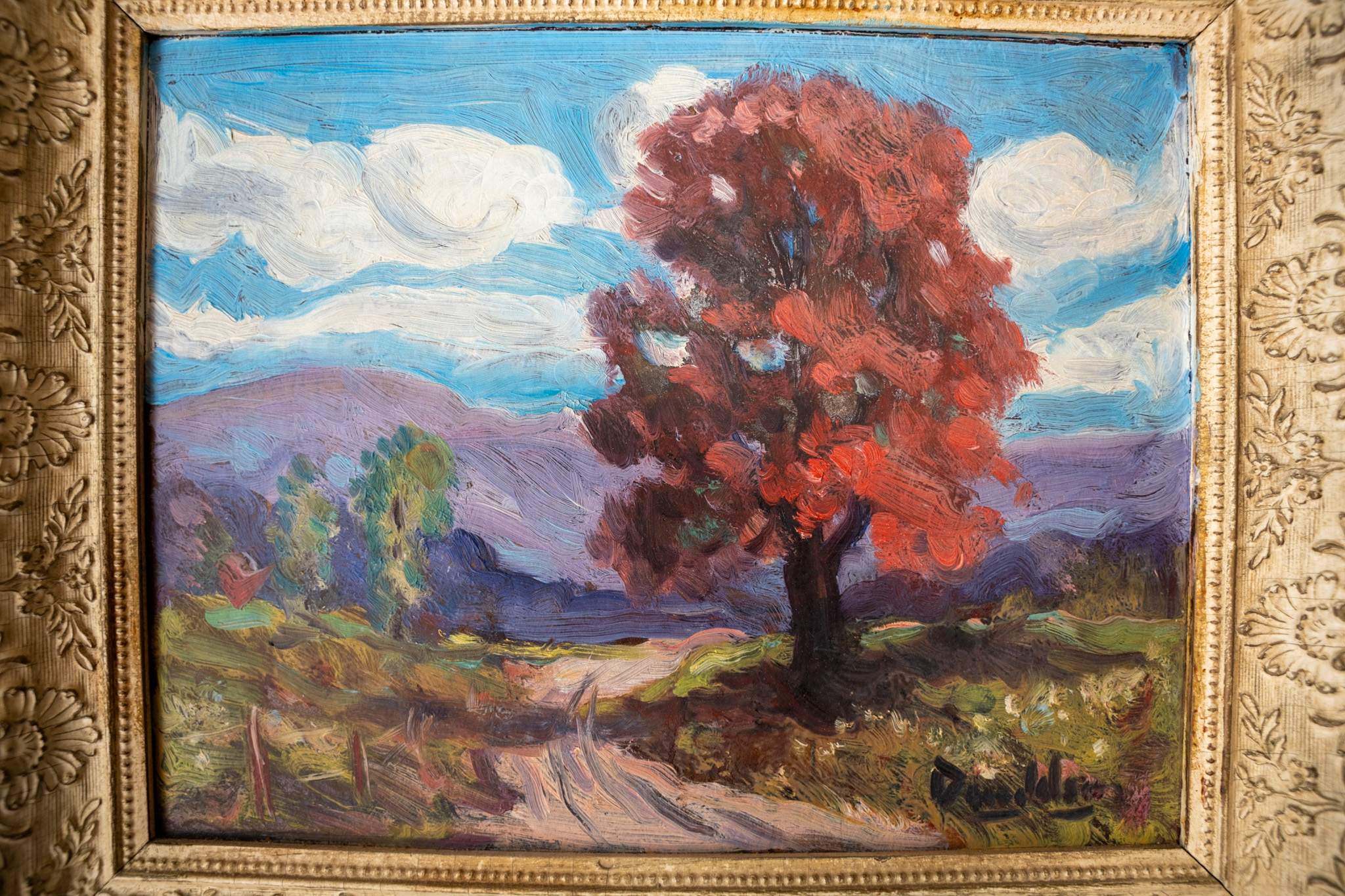 Composition detail | Austin Gallery
The subject — an autumn road through the southern Indiana hills — is characteristic of the Indiana Regionalist tradition and the Brown County Art Colony painters who made this landscape their life's work for over a century.
Technique
Donaldson painted in heavy impasto, leaving thick ridges of paint across the panel. The clouds are sculpted rather than blended. The tree canopy is built in layered strokes of red, orange, and green that merge at a distance but remain distinct up close. The handling is direct and confident — consistent with plein air technique and an artist working from observation.
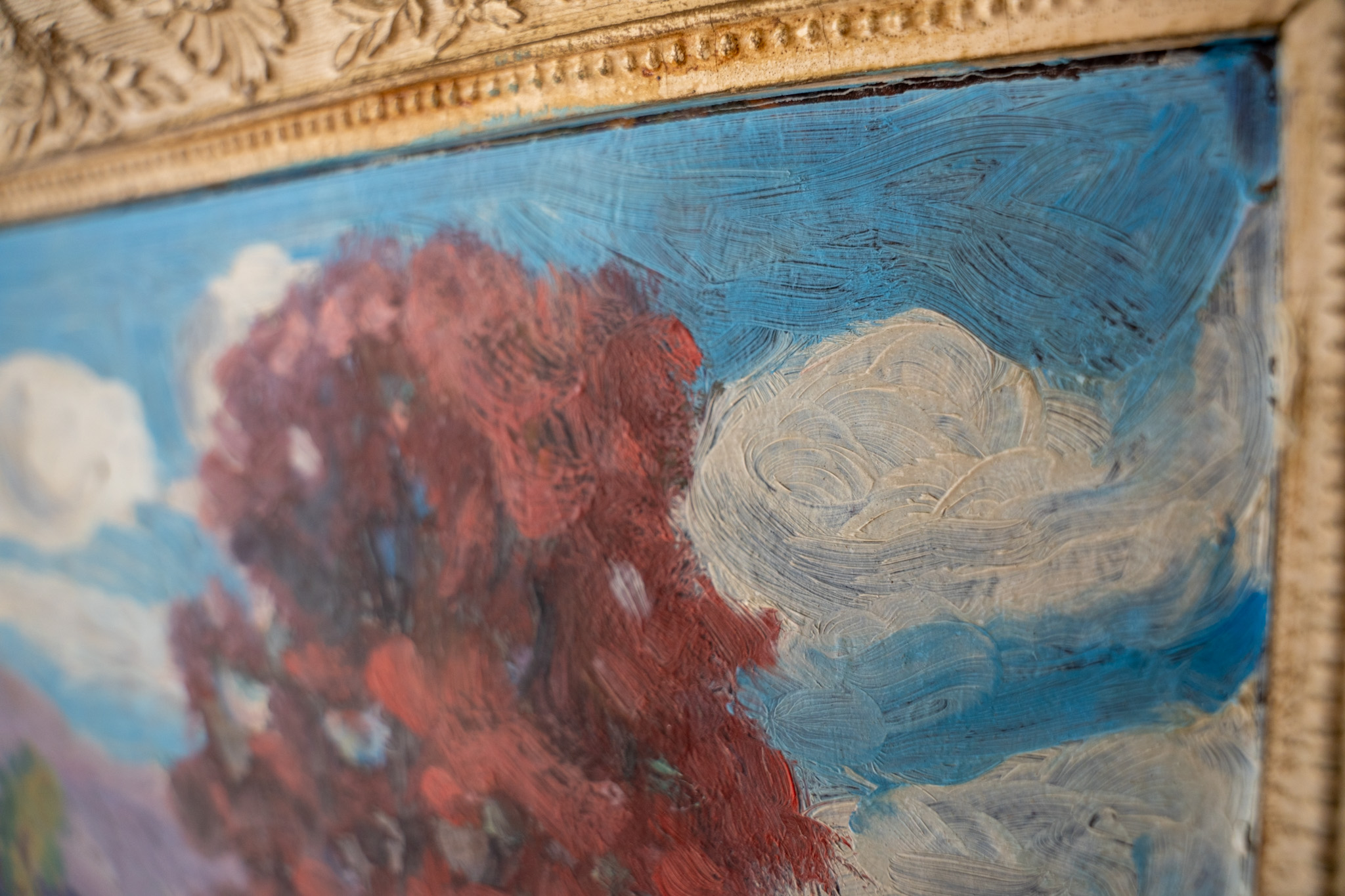 Impasto detail in the sky and canopy | Austin Gallery
Condition and Frame
The painting retains its original painted frame and is in un-restored condition.
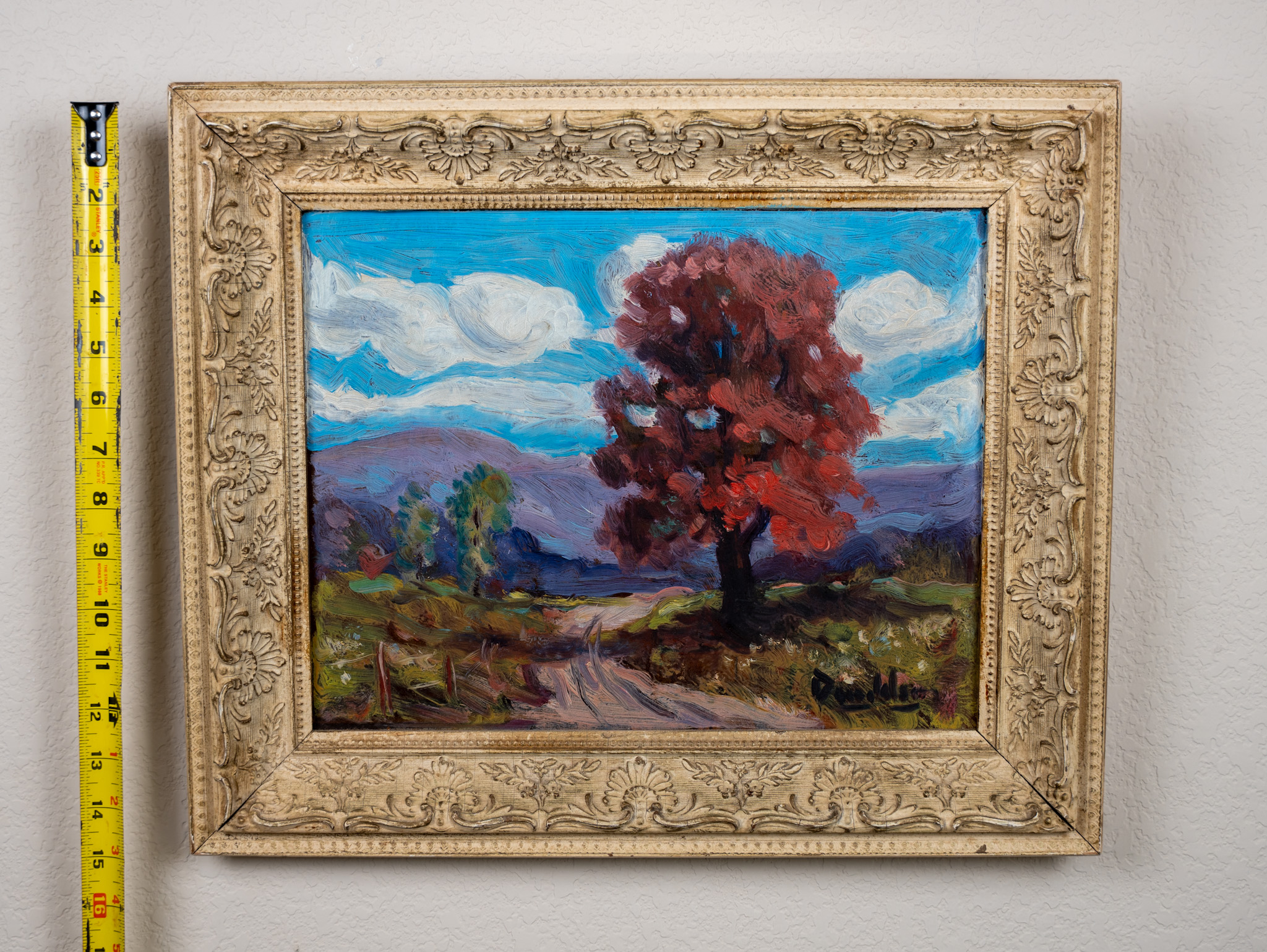 Framed height: 15½" | Austin Gallery
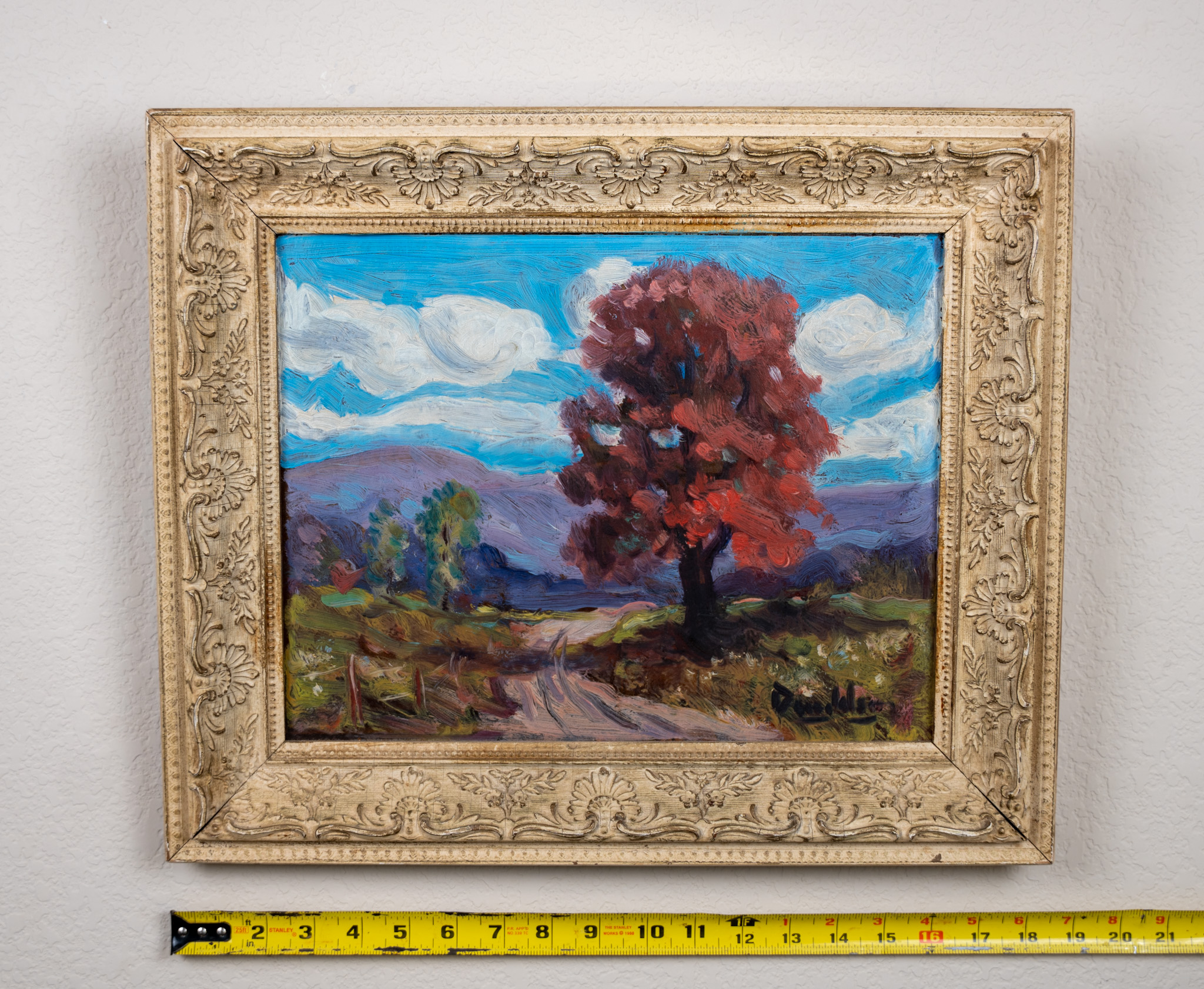 Framed width: 18½" | Austin Gallery
About the Artist
Lauchlan Donaldson was a mid-twentieth-century American painter active in Indiana. He worked in oil on board and panel, primarily painting autumnal landscapes of the Indiana countryside.
His signed works have appeared at auction through Joshua Kodner Galleries (Florida) and other regional houses. He is listed on MutualArt and askART.
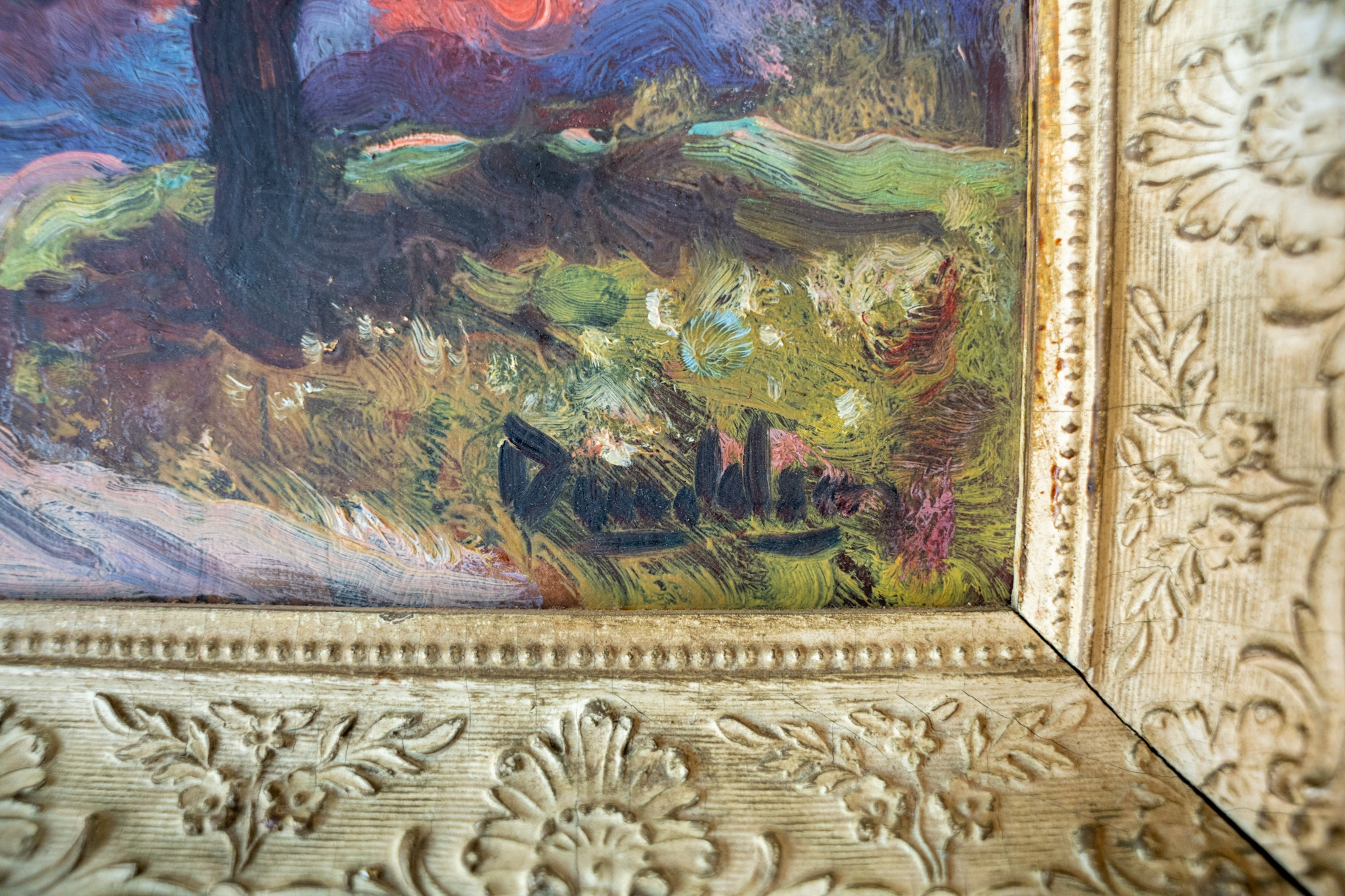 Donaldson's signature at lower right | Austin Gallery
No comprehensive biography or museum retrospective has been published. This is common for mid-century regional painters who exhibited locally, sold through regional galleries, and worked outside the New York art world. Many such artists are documented primarily through their surviving paintings and auction records.
Austin Art Insider
Free weekly guide to galleries, exhibitions & collecting in Austin.
"Down Indiana Way" (1955) places Donaldson squarely in Indiana's postwar landscape tradition — the same subject matter and techniques that painters in the state had been developing since the 1880s.
Indiana's Landscape Painting Tradition
Indiana has one of the longest continuous landscape painting traditions in the United States, stretching from the 1880s to the present. Donaldson worked within this lineage.
The Hoosier Group (1880s–1920s)
Five painters — T.C. Steele, William Forsyth, J. Ottis Adams, Otto Stark, and Richard Gruelle — trained at the Royal Academy in Munich and returned to Indiana to paint the state's landscape. T.C. Steele settled in Brown County in 1907 and spent the rest of his career painting the forested hills there. His work set the template for generations of Indiana landscape painters.
The Brown County Art Colony (1907–Present)
Steele's move sparked a full artist colony in and around Nashville, Indiana. Key members:
- Adolph Shulz — arrived c. 1900 from Chicago; the colony's unofficial founder
- Marie Goth — arrived 1920; stayed sixty years
- V.J. Cariani, Carl Graf, Dale Bessire, Leota Loop
Brown County sits in the unglaciated hills of south-central Indiana — rougher, more wooded terrain than the flat farmland elsewhere in the state. The autumn foliage — scarlet maples, gold hickories, orange oaks — has drawn painters for over 120 years. The colony rivaled Taos, Provincetown, and Old Lyme in both size and artistic output.
American Regionalism (1930s–1950s)
The national Regionalist movement — Grant Wood (Iowa), Thomas Hart Benton (Missouri), John Steuart Curry (Kansas) — championed rural American subjects. Indiana's own Regionalist wave centered on Donald Mattison at the John Herron Art Institute in Indianapolis, training painters who carried the tradition into the postwar years when Donaldson was active.
Autumn in Indiana Art
The fall foliage in southern Indiana rivals New England's. Mixed hardwood forests, rolling terrain, and low October light have made autumn the defining subject of Indiana landscape painting since T.C. Steele. Donaldson's red maple and golden hillsides in "Down Indiana Way" belong to this tradition.
Why Regional Paintings Matter
- Documentation — For lesser-known artists, the paintings themselves are the primary surviving record of their work and artistic affiliations.
- Art history — Mid-century Indiana landscapes fill gaps in the story of the state's art colony movement and its postwar evolution.
- Collecting — Work by skilled but under-recognized regional painters is often accessible at price points well below its quality.
Austin Gallery researches, documents, and presents works by both well-known and under-documented American artists.
Sell or Appraise a Regional American Painting
We specialize in mid-century American art and regional painters.
Have a painting by a regional artist? Get in touch.
Frequently Asked Questions
Who is Lauchlan Donaldson?
Lauchlan Donaldson was a mid-twentieth-century American painter active in Indiana. He painted oil-on-panel and oil-on-board landscapes, primarily autumnal Indiana scenes. His work has appeared at auction through Joshua Kodner Galleries and is listed on MutualArt and askART. Biographical documentation is limited, but his paintings show skilled impasto technique and a clear connection to Indiana's Regionalist landscape tradition.
Biographical documentation is limited, but his paintings show skilled impasto technique and a clear connection to Indiana's Regionalist landscape tradition.
What is Indiana Regionalist art?
Indiana Regionalist art refers to work by artists in Indiana's landscape tradition, from the early 1900s through the mid-twentieth century. It grew out of the Hoosier Group and the Brown County Art Colony and emphasizes the state's rolling hills, hardwood forests, and rural scenery. It overlaps with the broader American Regionalist movement of the 1930s–1950s led by Grant Wood and Thomas Hart Benton.
What is the Brown County Art Colony?
One of the most important artist communities in Midwestern history. It formed around 1907 when T.C. Steele moved to Brown County, Indiana, and attracted dozens of painters drawn by the area's autumn foliage and hilly terrain. Members include Adolph Shulz, Marie Goth, V.J. Cariani, and Dale Bessire. The colony remains active today in Nashville, Indiana.
How much is an Indiana Regionalist painting worth?
It depends on the artist, condition, size, subject, and provenance. Major Hoosier Group artists like T.C. Steele: $50,000–$500,000+. Brown County Art Colony painters: $1,000–$30,000. Lesser-known regional artists: $200–$5,000. Original framing and documented provenance increase value. Contact Austin Gallery for a free appraisal.
Where can I sell a mid-century American landscape painting?
Austin Gallery buys and consigns mid-century American art, including regional landscapes. We offer free in-home appraisals in Austin, Texas and accept consignments nationwide.
Insider Tip
Indiana Regionalist works remain undervalued compared to better-known Midwestern scene painters. Pieces from the 1950s represent the movement's peak quality.
Regionalism
An American art movement from the 1920s-1950s depicting rural and small-town scenes, celebrating local identity. Major figures include Grant Wood, Thomas Hart Benton, and John Steuart Curry.
An American art movement from the 1920s-1950s depicting rural and small-town scenes, celebrating local identity.


