
Key Takeaways
- Irving Amen was one of America's most prolific and celebrated printmakers, producing over 500 woodcuts in his career
- His humanist themes — peace, family, music — give his work enduring emotional resonance
- Amen's woodcuts are widely collected and remain accessible at various price points
In the world of fine art printmaking, few names carry as much weight as Irving Amen. Over a career spanning more than six decades, Amen created woodcuts, etchings, and linocuts that now reside in over 150 museum collections worldwide—from the Metropolitan Museum of Art and the Smithsonian to the Victoria and Albert Museum in London and the Bibliothèque Nationale in Paris.
In This Article
- The Making of a Master: From Child Prodigy to Pratt Institute
- War, Service, and Artistic Development
- The Woodcut Technique: Where Craftsmanship Meets Art
- Italy and the European Sojourn
- Museum Collections: A Legacy Carved in Wood
- Themes and Subjects: The Human Condition
- Teaching and Influence
- The Accademia Connection: Following Michelangelo
- Collecting Irving Amen: What to Look For
- Why Irving Amen Matters Today
- Currently Available: Audience at Tivoli
- Further Reading and Resources
- Conclusion
His work combines the technical mastery of the Old Masters with a distinctly modern sensibility, creating prints that feel simultaneously timeless and immediate. For collectors seeking original works by an artist whose legacy is firmly established in museum collections, Amen represents an exceptional opportunity to own museum-quality art at accessible price points.
The Making of a Master: From Child Prodigy to Pratt Institute
Irving Amen was born in New York City in 1918, and his artistic awakening came remarkably early. As he once told a reporter with characteristic wit, "I discovered art at four years old. I missed the first four years. I guess I messed around."
Irving Amen was born in New York City in 1918, and his artistic awakening came remarkably early.
That early passion proved prophetic. By age fourteen, Amen had earned a scholarship to the prestigious Pratt Institute, where he would study from 1932 to 1939. It was at Pratt that Amen developed his lifelong admiration for Michelangelo—an artist whose influence would shape every aspect of Amen's career.
"Amen idolized Michelangelo's draftsmanship and, like the Renaissance master, spent years perfecting his drawing skills through the study of both live models and Michelangelo's works," notes the Samuel Dorsky Museum of Art at SUNY New Paltz, which holds examples of his work in their permanent collection.
This dedication to classical training in figure drawing would become the foundation of Amen's distinctive style—prints that marry technical precision with emotional depth, anatomical accuracy with expressive power.
War, Service, and Artistic Development
From 1942 to 1945, Amen served in the Armed Forces, where he headed a mural project and executed murals in both the United States and Belgium. This experience proved formative in unexpected ways. The large-scale work required for murals trained his eye for composition, while the wartime experience deepened his understanding of human nature—themes that would permeate his later work.
After his military service, Amen returned to New York City and opened a studio in Greenwich Village, followed later by a larger space in the Garment District. It was here that he would develop the woodcut technique that would define his legacy.
His first exhibition of woodcuts was held at The New School for Social Research in New York, and his second at the Smithsonian Institution in 1949—a remarkable early validation of his talent from one of America's most prestigious cultural institutions.
The Woodcut Technique: Where Craftsmanship Meets Art
What sets Irving Amen's prints apart is not simply their subject matter but their extraordinary technical execution. Woodcut printing—one of the oldest printmaking techniques dating back to ancient China—requires the artist to carve an image into a block of wood, then apply ink to the raised surfaces and press paper against it to create a print.
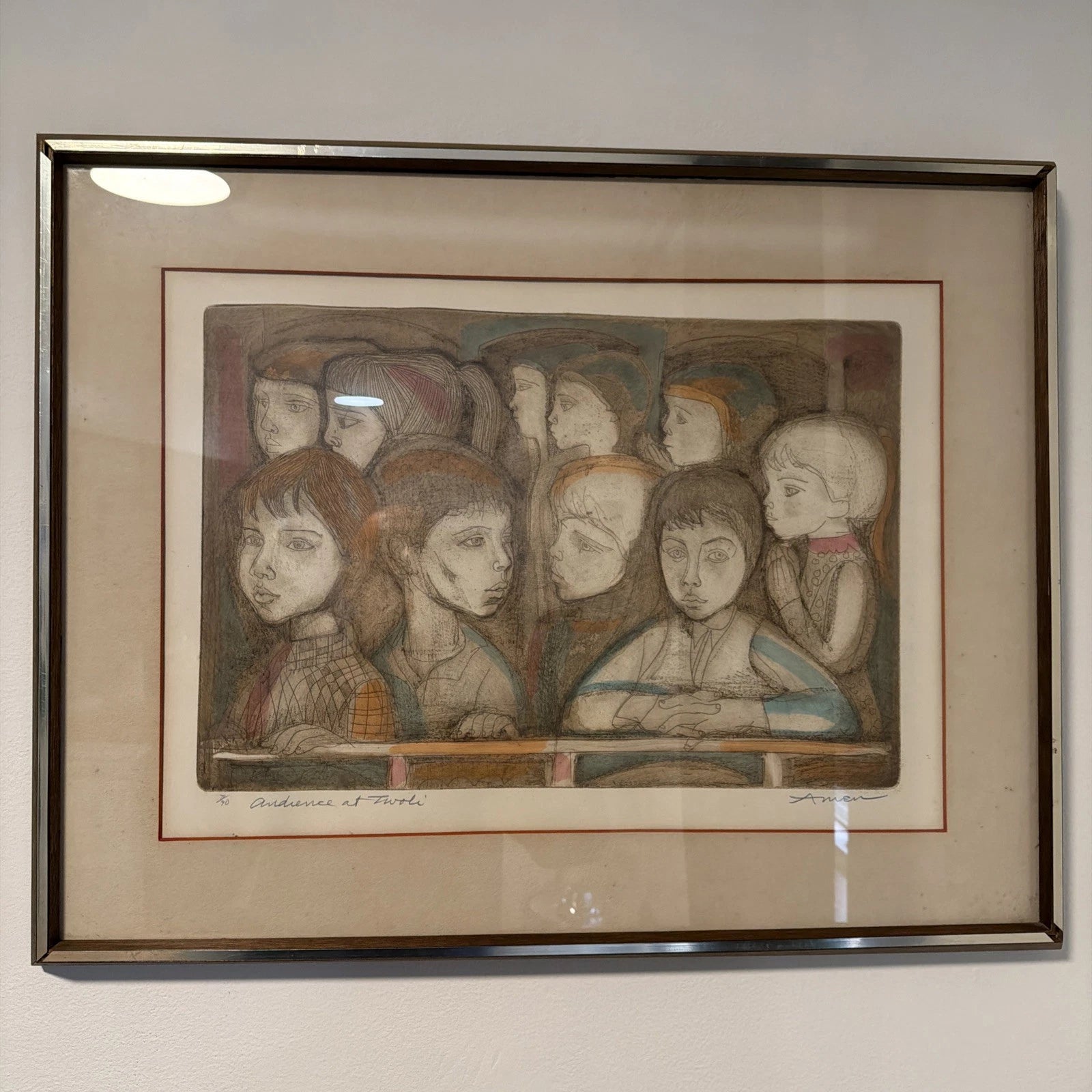 "Audience at Tivoli" (1970s) - Signed and numbered woodcut by Irving Amen. Edition 7/90. Available in our collection.
The difficulty lies in the reversal required—the artist must think in negative space, carving away what will not print. Every line, every texture must be planned in advance and executed with precision. Unlike painting, where mistakes can be covered or corrected, woodcut printing demands absolute commitment to each cut.
Amen elevated this ancient technique through his innovative use of color. Rather than creating simple black-and-white prints, he frequently applied different colored inks to the raised portions of his woodcuts—an exacting process that required multiple printings, each precisely aligned, to build complex, luminous images.
As the Dorsky Museum notes of his Piazza San Marco series: "As is evident in the print, Amen frequently applied different colored inks to the raised portions of his woodcuts, an exacting process. He used multiple color blocks to replicate the emblematic features of Venice's famous piazza."
Essential Tools for Aspiring Printmakers
For those inspired by Amen's mastery to explore printmaking themselves, quality tools make all the difference:
Italy and the European Sojourn
In 1950, Amen traveled to Paris to study, absorbing the influences of European modernism while maintaining his commitment to figurative tradition. But it was his 1953 journey throughout Italy that would produce some of his most celebrated work.
The trip resulted in a remarkable series: eleven woodcuts, eight etchings, and numerous oil paintings depicting various Italian cities. One of these woodcuts, "Piazza San Marco #4," along with its four woodblocks, was acquired by the Smithsonian Institution as a permanent exhibit demonstrating the block printing technique in color.
This series exemplified Amen's unique ability to capture the essential character of place—the play of light on ancient stone, the movement of crowds through historic spaces, the architectural grandeur of centuries-old buildings—all rendered through the stark contrasts and bold lines of the woodcut medium.
Museum Collections: A Legacy Carved in Wood
The true measure of an artist's significance often lies in institutional recognition. By this standard, Irving Amen stands among the most important American printmakers of the 20th century. His work resides in over 150 museum collections worldwide, including:
Major U.S. Museums:
- Museum of Modern Art, New York
- The Metropolitan Museum of Art, New York
- National Gallery of Art, Washington, D.C.
- Smithsonian American Art Museum, Washington, D.C.
- Art Institute of Chicago
- Boston Museum of Fine Arts
- Philadelphia Museum of Art
- Whitney Museum of American Art
- Harvard Art Museum
- Yale University Art Gallery
- Library of Congress
International Institutions:
- Victoria and Albert Museum, London
- Bibliothèque Nationale, Paris
- Albertina Museum, Vienna
- Fitzwilliam Museum, Cambridge
This extraordinary institutional presence means that when you acquire an Irving Amen print, you're collecting work by an artist whose legacy is preserved alongside the greatest names in art history.


