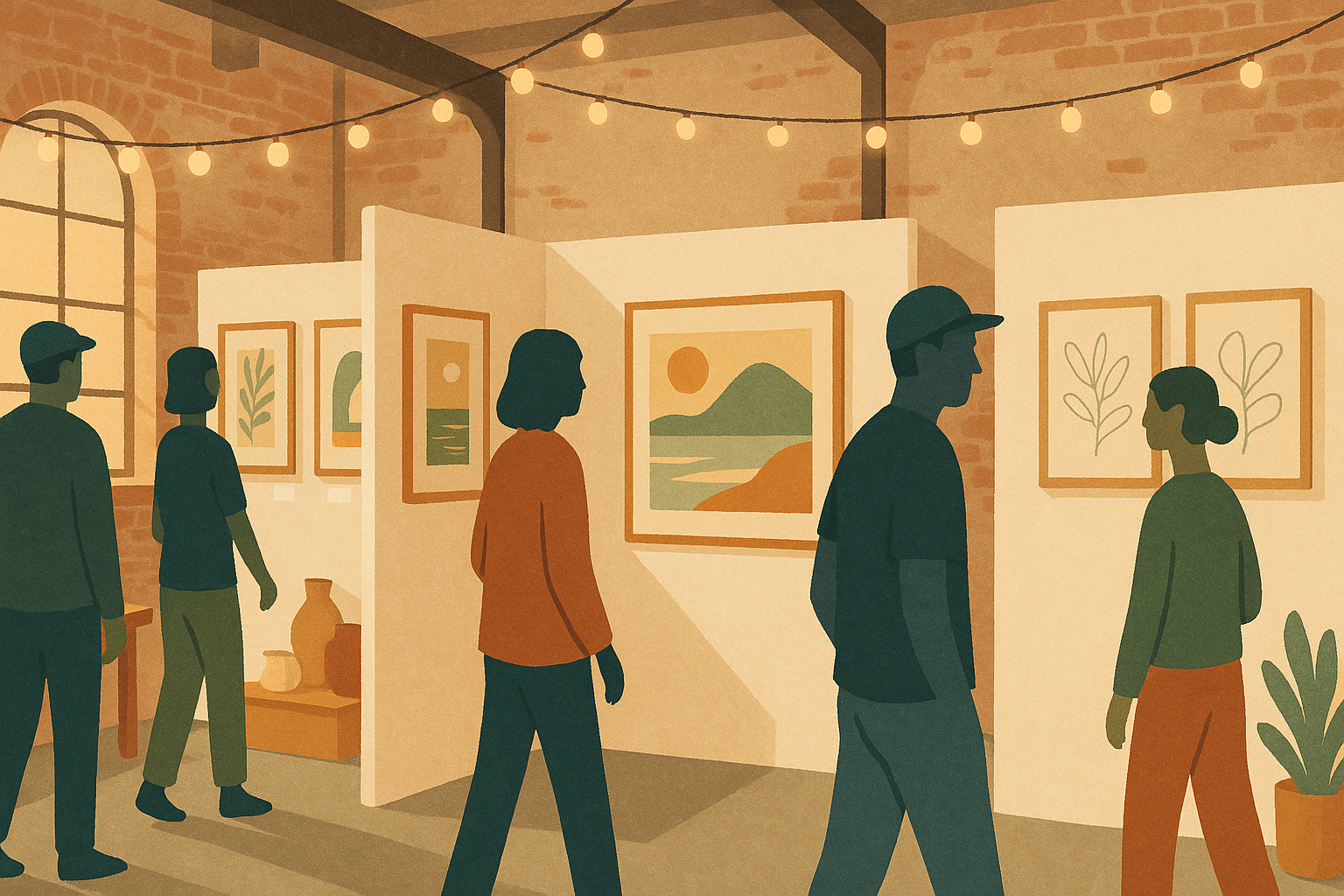
Every November, Austin becomes the largest open-studio event in America. 500+ artists throw open their doors, and for two weekends, you can walk into working studios, meet creators, and buy art at prices galleries can't match.
In This Article
Key Takeaways
- EAST (East Austin Studio Tour) happens over two weekends in November — free and open to everyone
- 500+ participating artists at 100+ locations across East Austin
- Studio prices are typically 30-50% below gallery retail — the best deals of the year
- The companion West Austin Studio Tour (WEST) happens in May with 200+ artists
- Plan a focused route of 8-12 studios per day; trying to see everything guarantees you see nothing well
What Is EAST?
The East Austin Studio Tour began in 2003 as a small group of artists opening their studios to the public. It has since grown into one of America's most significant open-studio events, drawing tens of thousands of visitors across two November weekends.
The concept is simple: Working artists open their studios, show their work, explain their process, and sell directly to visitors. No gallery commissions, no intermediaries, no pretension. Just artists and the people who want to see their work.
For first-time visitors who want a deeper primer on what to expect inside a working studio — and how to behave once you are there — read our companion piece on visiting artists' studios. Joe Fig's Inside the Artist's Studio is also a worthwhile read in the weeks leading up to EAST; it gives you a visual library of what working studios actually look like, so you walk in calibrated rather than overwhelmed.
How to Plan Your Visit
Before You Go
- Download the map from the official EAST website (available 2-3 weeks before)
- Mark your priorities — you can't see everything, so identify 10-15 studios you want to hit
- Check artist websites — preview the work so you're not walking in blind
- Bring cash — many artists prefer it for smaller purchases. Also bring Venmo
- Wear comfortable shoes — you'll walk 3-5 miles
Timing Strategy
| Day | Best For |
|---|---|
| Saturday morning (10am-noon) | Serious buying — fresh work, full inventory |
| Saturday afternoon (1-5pm) | Social scene — crowds, energy, food trucks |
| Sunday | More relaxed, fewer crowds, some artists more available for conversation |
| Weekend 2 | Studios restocked, smaller crowds, sometimes lower prices on remaining work |
What to Budget
| Budget | What You'll Get |
|---|---|
| $0 | A great day out — EAST is free to attend |
| $50-100 | Prints, postcards, small ceramics, stickers |
| $100-300 | Limited edition prints, small paintings, handmade jewelry |
| $300-500 | Original paintings, sculpture, mixed media — the sweet spot |
| $500-1,000 | Substantial pieces from mid-career artists |
| $1,000+ | Large originals from established artists |
What to Bring on the Tour
EAST is a long weekend on your feet, often in unpredictable November weather. The kit I have refined over a decade of tours:
- A folding canvas tote with a flat bottom. A reinforced canvas tote is essential — you will end up with prints, zines, ceramics, and mailing tubes by mid-afternoon. The flat-bottom variety stands upright and prevents creases on works on paper.
- A flat archival folder for prints. A small acid-free art portfolio or print folder keeps anything under 11x14 from getting bent in transit. The most expensive lesson new collectors learn is what a folded edge does to the value of a signed limited print.
- A pocket notebook and pen. A pocket Moleskine or Field Notes is what I use to jot the artist's name, studio number, and a one-line description of any piece I am considering. Phones look like inattention; a real notebook signals respect.
- A water bottle and a power bank. Studio hopping eats phones — between maps, photos, and Venmo, you will run a battery flat by 3pm. A 10,000 mAh battery pack is plenty.
- Comfortable walking shoes. Three to five miles of concrete and gravel. Save the leather soles for the gallery openings later.
If you want to read up on the broader collector mindset before EAST weekend, Sarah Thornton's Seven Days in the Art World and Mary Rozell's The Art Collector's Handbook are the two books I most often recommend. Thornton gives you the social geography; Rozell gives you the business mechanics.
The Major Hubs
Canopy Art District — 916 Springdale Rd
The single biggest concentration of EAST studios. 45+ artists under one roof (a former Goodwill warehouse). Three galleries, outdoor art, food vendors, and a cafe. Plan at least 90 minutes.
Bolm Road Studios
A cluster of studios along Bolm Road near the airport. More industrial, more experimental. This is where you find the artists who are pushing boundaries.
Cesar Chavez Corridor
Studios and galleries lining East Cesar Chavez from I-35 to Pleasant Valley. Walkable, with restaurants and cafes for breaks between studios.
Springdale Road
North of Cesar Chavez, Springdale has seen an explosion of studios in converted warehouses and industrial spaces. The art here tends to be larger-scale.
Buying Tips
Ask about the work. Artists at EAST are there specifically to talk about what they make. Ask about materials, process, inspiration. This isn't a gallery where you browse silently.
Check for red dots. A red dot means the piece is sold. If a piece you love already has a red dot, ask if the artist has similar work or accepts commissions.