The Complete Guide to Art Fairs for New Collectors (2025-2026 Edition)
A comprehensive guide to navigating art fairs as a new collector. From Art Basel and Frieze to regional fairs in Texas, learn how to prepare, what to expect, and how to buy with confidence. Includes fair calendar, pricing insights, and practical tips.
By Austin Gallery
This article contains affiliate links. Austin Gallery may earn a commission at no cost to you.
Walking into your first art fair can feel like stepping onto a trading floor where everyone else already knows the rules. Hundreds of gallery booths, thousands of artworks, crowds of collectors moving with purpose — it's exhilarating and overwhelming in equal measure. But here's the thing: art fairs are one of the best places for new collectors to see a massive range of work, meet gallery owners face-to-face, and start building the relationships that will define your collecting life. After attending dozens of fairs across the country over the past decade, I've learned that a little preparation turns an intimidating experience into one of the most productive days you can spend in the art world. This guide covers everything you need to know — from choosing the right fair to walking out with a piece you'll love for decades.
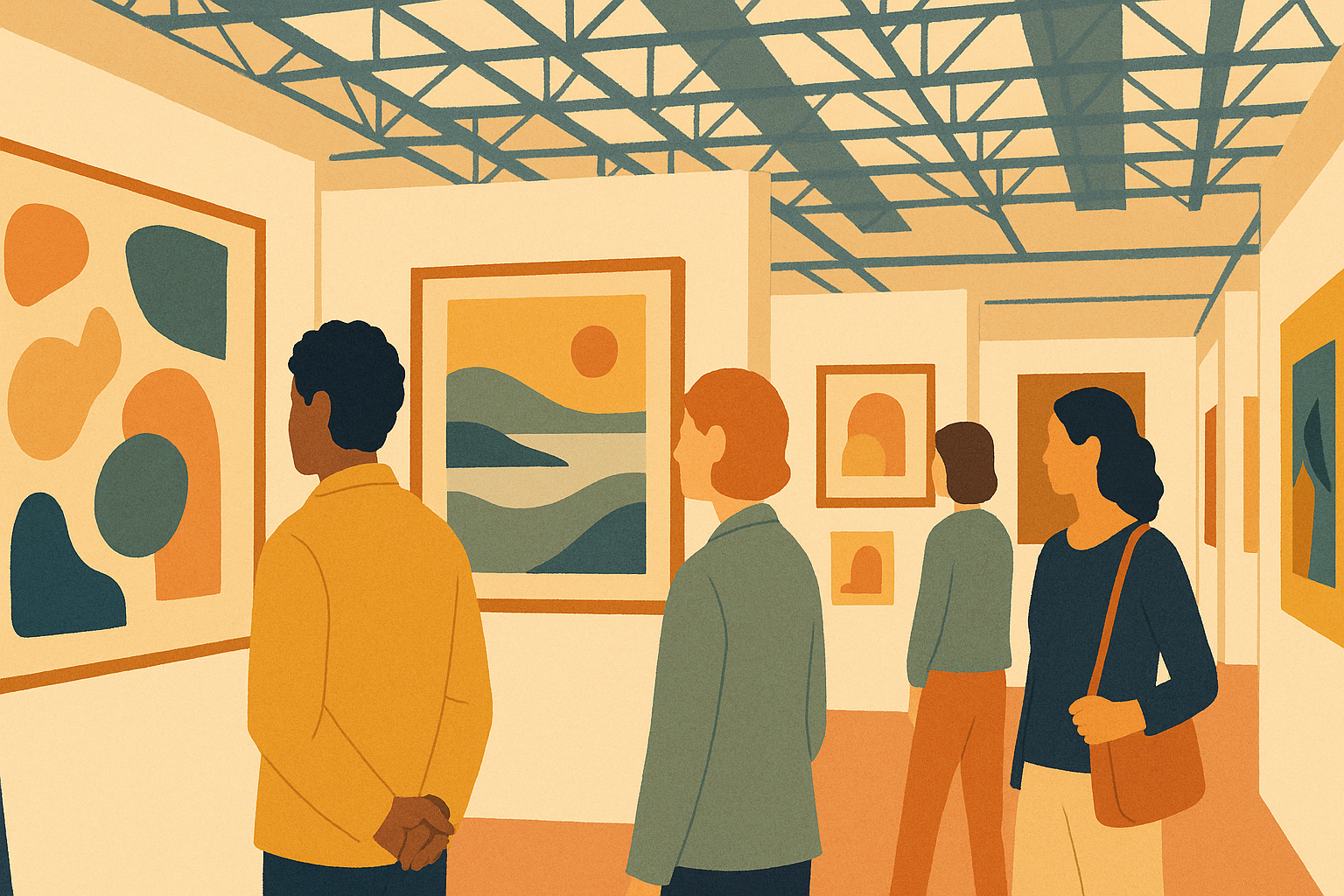
An art fair is essentially a curated marketplace where galleries rent booth space to exhibit and sell artwork. Think of it as a temporary museum where everything is for sale. The fair organizer vets applying galleries, ensuring a baseline quality level, and then galleries bring their strongest inventory — usually a mix of established artists and newer talent they're betting on.
Most fairs run Thursday through Sunday. Thursday is typically a VIP preview day (more on that below), with public hours Friday through Sunday. Admission ranges from free to around $50 depending on the fair's prestige. Inside, you'll find anywhere from 30 booths at a small regional fair to 250+ at an international powerhouse like Art Basel.
$50
Admission ranges from free to around depending on the fair's prestige
Admission ranges from free to around $50 depending on the fair's prestige.
The business model matters for you as a buyer: galleries pay significant booth fees (often $20,000 to $100,000+ at major fairs), which means they're motivated to sell. This creates a unique dynamic where dealers are more accessible and sometimes more flexible than they would be in their home galleries. If you've been hesitant about walking into a gallery for the first time, a fair eliminates that barrier entirely — everyone is there to look, talk, and potentially buy.
Types of Art Fairs: Finding Your Level
Not all fairs are created equal, and understanding the tiers helps you invest your time (and money) wisely.
Blue-Chip and International Fairs
These are the headliners: Art Basel (Miami Beach, Basel, Hong Kong, Paris), Frieze (New York, Los Angeles, London, Seoul), and The Armory Show in New York. Expect work by household-name artists, prices that start in the five figures and climb into the millions, and a social scene that blurs the line between art world and celebrity culture. For new collectors, these fairs are outstanding educational experiences even if you're not buying. You'll see museum-quality work up close, overhear fascinating conversations, and develop your eye faster than months of gallery visits could accomplish.
Mid-Tier and Regional Fairs
This is where most new collectors should focus their buying energy. Fairs like EXPO Chicago, the Dallas Art Fair, San Francisco Art Fair (formerly Art Market San Francisco), and Untitled Art bring strong galleries with more accessible price points. You'll find emerging and mid-career artists with work ranging from $500 to $50,000. The atmosphere is less frenetic, dealers have more time to talk, and the discovery factor is higher — you're more likely to find an artist here before the rest of the market catches on.
Satellite and Emerging Fairs
Satellite fairs pop up around major fairs, offering even more experimental and affordable work. During Miami Art Week, for example, dozens of satellite fairs like NADA, Untitled, and Pulse run alongside Art Basel. These are goldmines for collectors on a budget, with works sometimes starting under $200.
If you're just starting out, I'd strongly recommend reading The Art of Buying Art by Alan Bamberger before attending your first fair. It's the most practical guide available on evaluating and purchasing art with confidence, and the latest edition covers online buying too.
Your 2025-2026 Art Fair Calendar: Major U.S. Fairs
Plan your year around these dates. Booking travel early — especially for Miami in December — saves serious money.
Spring 2025
Dallas Art Fair — April 10-13, 2025 | Fashion Industry Gallery, Dallas | dallasartfair.com
San Francisco Art Fair — April 17-20, 2025 | Fort Mason Center, San Francisco | sanfranciscoartfair.com
EXPO Chicago — April 24-27, 2025 | Navy Pier, Chicago | expochicago.com
Frieze New York — May 7-11, 2025 | The Shed, New York | frieze.com
Fall 2025
The Armory Show — September 4-7, 2025 | Javits Center, New York | thearmoryshow.com
Untitled Art, Houston — September 19-21, 2025 | George R. Brown Convention Center, Houston
Austin Studio Tour (EAST) — November 8-9 and 15-16, 2025 | Citywide, Austin | atxstudiotour.com
Art Basel Miami Beach — December 5-7, 2025 | Miami Beach Convention Center | artbasel.com
Spring 2026
Frieze Los Angeles — February 26-March 1, 2026 | Santa Monica Airport | frieze.com
EXPO Chicago — April 9-12, 2026 | Navy Pier, Chicago | expochicago.com
Dallas Art Fair — April 16-19, 2026 | Fashion Industry Gallery, Dallas | dallasartfair.com
San Francisco Art Fair — April 16-19, 2026 | Fort Mason Center, San Francisco | sanfranciscoartfair.com
Fall 2026
The Armory Show — September 24-27, 2026 | Javits Center, New York | thearmoryshow.com
Untitled Art, Houston — October 2-6, 2026 | George R. Brown Convention Center, Houston
Art Basel Miami Beach — December 4-6, 2026 | Miami Beach Convention Center | artbasel.com
Frieze New York — May 13-17, 2026 | The Shed, New York | frieze.com
The collectors who get the most out of fairs do their homework. Here's a pre-fair routine that works.
Research the Exhibitor List
Every fair publishes its gallery list weeks in advance. Spend an evening browsing each gallery's website and Instagram. Flag the ones showing artists whose work resonates with you. Most fairs also release a floor map — mark the booths you want to hit first, because your energy and attention are sharpest in the first two hours.
Set a Real Budget
Decide before you arrive what you can spend, and be honest with yourself. Art fair energy is contagious; it's easy to get swept up. Having a firm number in mind — whether that's $500 or $50,000 — keeps your decision-making clear. Remember that the purchase price is just the starting point. Factor in framing (which can run $200 to $2,000+), shipping, and potentially sales tax.
You will walk miles. Wear comfortable shoes — this is non-negotiable. Dress smart-casual. You want to be taken seriously by dealers but also be physically comfortable enough to spend four to six hours on your feet. Leave the heels and stiff dress shoes at home.
Navigating the Fair Floor Like a Pro
The Two-Pass Strategy
On your first pass, walk the entire fair without buying anything. Seriously. See everything, take photos (ask first — most booths allow it), and collect business cards from galleries showing work you like. Grab a coffee, sit down, and review your photos. Then go back for a focused second pass to the booths that stood out. This approach prevents impulse purchases and ensures you don't miss something extraordinary tucked in a back corner.
How to Talk to Dealers
Gallery dealers at fairs range from the gallery owner to junior staff. Don't be intimidated. Start with genuine curiosity: "Can you tell me about this artist?" or "What's the story behind this piece?" Dealers love educating enthusiastic newcomers because today's $2,000 buyer might be tomorrow's $200,000 client. If you want to go deeper on gallery conversations, check out our piece on how to talk to artists and gallery owners.
Austin Art Insider
Free weekly guide to galleries, exhibitions & collecting in Austin.
Avoid the classic mistake of asking "How much is this?" as your opening line. Look, engage with the work first, ask questions about the artist, then inquire about price. It shows you're a serious collector, not a casual browser.
Read the Room
If a dealer is mid-conversation with another collector, don't hover awkwardly. Move on and circle back. If a booth is empty, that's your chance for an extended, unhurried conversation. Late afternoons on the final day tend to be quieter and can yield the best dealer interactions.
How Pricing Works at Art Fairs
Art fair pricing follows gallery conventions, but with some quirks worth understanding.
Price Lists and the Red Dot System
Most booths have a price list available at the front desk — just ask. Some fairs require all prices to be displayed. A red dot next to a work means it's sold. Multiple red dots early in a fair signal a hot artist or gallery, which is useful market intelligence even if you're not buying that particular piece.
The Markup Question
Gallery prices at fairs should be the same as in the gallery's brick-and-mortar space. Ethical galleries don't inflate prices for fairs. The standard gallery commission is 50% of the sale price, which the artist and gallery split. This is true whether you buy at a fair or at the gallery six months later.
Negotiation: When and How
Here's where insider knowledge matters. Art prices are more negotiable than most new collectors realize, but the approach matters.
Don't negotiate on the fair's opening day. Galleries expect to sell at full price during the VIP preview and first public day.
Saturday afternoon and Sunday are the sweet spot. Galleries are more motivated to avoid packing unsold work back into crates.
A 10-15% discount is a reasonable ask for works priced above $5,000. Below that, margins are tighter and there's less room.
Phrase it as a question, not a demand. "Is there any flexibility on the price?" works far better than "I'll give you $3,000."
Buying multiple works from the same gallery gives you real leverage. Dealers will often discount a package deal because the total revenue is higher.
Payment terms are another form of negotiation. Many galleries will let you pay in two or three installments, which effectively gives you an interest-free loan.
For a comprehensive understanding of how the art market works, I recommend The Art Collector's Handbook by Mary Rozell. It covers everything from acquisition to insurance to eventually selling — essential reading for anyone building a serious collection.
After years of trial and error, here's what I never attend a fair without:
Portable phone charger — you'll drain your battery taking photos and notes
A small tape measure — to check if a piece will actually fit your wall space
Business cards — yes, even in 2025; gallery staff still hand them out and expect them
A tote bag or backpack — for catalogs, press materials, and the small works you might carry out
A notebook or notes app — write down booth numbers, artist names, and prices; you'll forget otherwise
Water bottle and snacks — fair food is overpriced and the lines are long
A photo of your wall space — showing a dealer exactly where you plan to hang a work helps them (and you) visualize scale
Red Flags: What to Watch Out For
Pressure Tactics
"This artist is selling out fast" or "Someone else is interested" may be true, but it can also be a high-pressure tactic. A reputable gallery will hold a work for 24 hours if you need to think. If they won't, that tells you something about how they do business.
Missing Provenance
For secondary market works (pieces being resold rather than sold for the first time), always ask about provenance — the ownership history. Legitimate sellers can provide documentation. Gaps in provenance are a red flag.
No Gallery Representation
At reputable fairs, every booth represents an established gallery. Be cautious at unvetted or unregulated fairs where individual sellers or unofficial dealers may operate without the same accountability. Stick to fairs with juried applications.
Authenticity Certificates
For prints and editions, always confirm you'll receive a certificate of authenticity (COA) and that the edition number is clearly documented. For unique works, request any available documentation of the artist's exhibition history.
Texas Art Fairs: Your Regional Guide
Living in Texas puts you within driving distance of some outstanding fairs — and you don't need to fly to Miami or New York to start your collection.
Dallas Art Fair
The Dallas Art Fair has become one of the most important regional fairs in the country. Held every April at the Fashion Industry Gallery in the Dallas Arts District, it draws 90+ galleries from across the U.S. and internationally. Price points range widely, and the surrounding Dallas Arts District — with the Nasher Sculpture Center, Dallas Museum of Art, and Crow Museum of Asian Art all within walking distance — makes it a full art weekend. The fair's "Dallas Art Fair Foundation Acquisition Program" has placed works in the Dallas Museum of Art's permanent collection, which speaks to the quality level.
Untitled Art, Houston
After the closure of the long-running Texas Contemporary fair, Untitled Art expanded to Houston in 2025, filling a major gap in the Texas art calendar. Held at the George R. Brown Convention Center, it brings the same curatorial rigor that made their Miami edition a collector favorite. The Houston fair is particularly strong in emerging and mid-career Latin American and Southern U.S. artists.
Austin Studio Tour (EAST)
If you're local to Austin, the Austin Studio Tour — formerly the East Austin Studio Tour — is unmissable. Held over two weekends in November, it opens 500+ artist studios across the city. This isn't a traditional art fair, but it's one of the best ways to buy directly from artists, see how work is made, and build relationships that last. Prices are often significantly lower than gallery prices since there's no middleman. It's also a perfect introduction to the depth and diversity of Austin's creative community. For more on what makes the local scene special, see our guide to the Austin art scene.
VIP access — typically available through gallery relationships, fair memberships, or premium ticket purchases ($150-$500) — gets you into the fair hours or a full day before the general public. Is it worth it?
For serious buyers: absolutely. The best works sell during VIP previews. If you've researched a specific piece and know you want it, you need to be there when the doors open. Galleries often pre-sell to their top clients even before VIP day, so being on a gallery's preferred list matters.
For new collectors still learning: maybe not. The general admission days offer a more relaxed atmosphere, more time with dealers, and the same educational value. Save the VIP ticket money and put it toward your first purchase.
The path to VIP access is straightforward: buy from galleries, attend their openings, get on their mailing lists, and build genuine relationships. Most galleries will eventually offer you VIP passes to fairs where they exhibit.
Online Art Fairs and Virtual Viewing Rooms
The pandemic permanently changed how fairs operate. Most major fairs now offer online viewing rooms (OVRs) that launch alongside or just before the physical event. Platforms like Artsy partner with fairs to let you browse, inquire, and even purchase remotely.
Online viewing rooms are excellent for research — you can study an artist's work, compare prices across galleries, and make a shortlist before arriving in person. Some collectors even purchase online when they can't attend in person.
However, nothing replaces seeing work in person. Color, texture, scale, and the way a piece commands space — these are things no screen can replicate. Use online tools as supplements, not substitutes, for the in-person experience.
Art fairs aren't one-time events. The collectors who build the strongest collections treat fairs as an annual rhythm — a structured way to stay current with the market, deepen gallery relationships, and add to their holdings over time.
Start with your local and regional fairs. Visit the Dallas Art Fair this April and the Austin Studio Tour in November. When you're ready for a bigger stage, fly to The Armory Show or Art Basel Miami Beach. Each fair will sharpen your eye and expand your network.
If you're just beginning to think about what kind of collector you want to be, start with our guide to starting a small art collection. The best collection isn't the most expensive one — it's the one that reflects a genuine, evolving engagement with art.
The best collection isn't the most expensive one — it's the one that reflects a genuine, evolving engagement with art.
The fair circuit rewards consistency. The dealers you meet this year remember you next year. The artists you discover at a regional fair might headline a major museum show in five years. Every conversation, every business card, every piece you bring home is a thread in a larger story — your story as a collector.
See you on the fair floor.
Share
Austin Art Insider
Free weekly guide to galleries, exhibitions & collecting in Austin.
Consignment
Have Art You Want to Sell?
Free appraisals, zero upfront fees, nationwide service from Austin, Texas.